
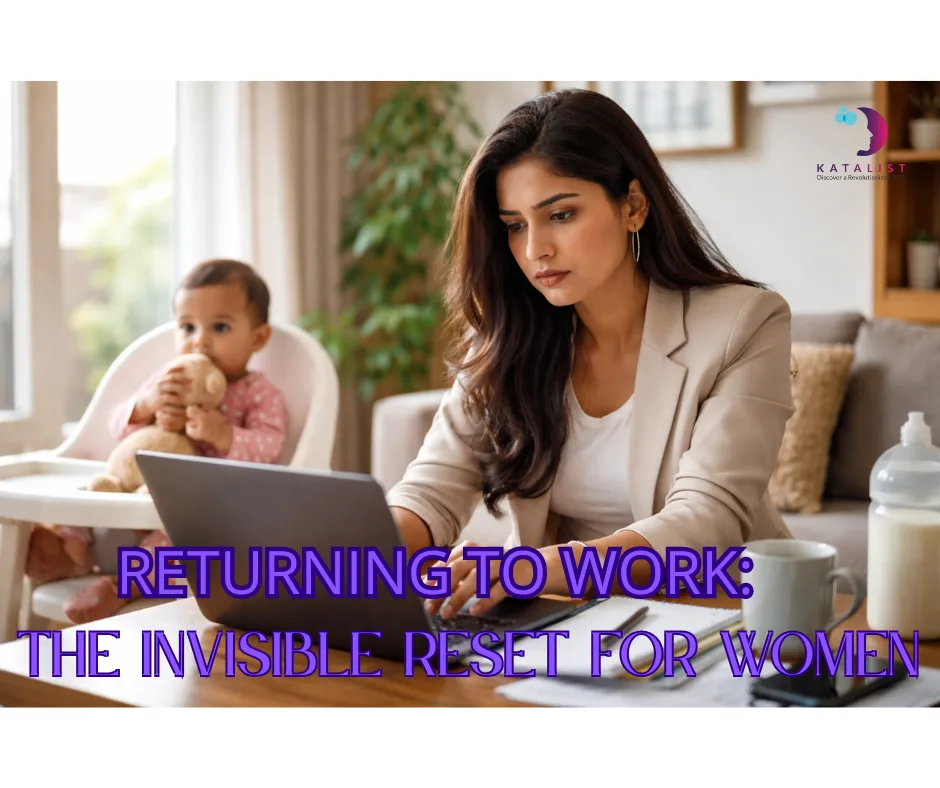
For many women, returning to work after a break—whether for maternity, caregiving, or a planned sabbatical—is not a smooth “re-entry.”
It is a quiet, often invisible struggle.
I know this not just as a coach, but from lived experience.
After my maternity break, I had to extend my time away due to health reasons. By the time I returned, the organisation had moved on—as it always does. My role had evolved. I was placed in a different team. The annual performance cycle had passed me by. Years of hard work and credibility felt erased.
I was starting from zero.
The Invisible Reset
No one explicitly said, “You have to prove yourself again.”
But that was the unspoken reality.
I was constantly catching up—on context, on relationships, on decisions that had already been made. There was little acknowledgment of what I brought with me. Only quiet expectations of performance, as though there had never been a pause.
And every evening, after a full day of work, I stepped into my second job: motherhood.
There were no breaks between roles. Just a deep exhaustion and a growing sense of being unseen and unsupported.
This is a story many women recognise instantly.
The Challenges Women Commonly Face on Re-Entry
Women returning to work after a break often face a unique combination of challenges:
- Loss of professional momentum
Missed ratings, promotions, or key projects create a sense of being left behind. - Changed roles and expectations
The job you return to is often not the job you left. - Unspoken bias
Assumptions about reduced ambition, availability, or commitment quietly shape opportunities. - Emotional and physical load
Recovery, caregiving, and mental adjustment happen alongside full performance expectations. - A constant need to “prove” relevance again
As if prior capability has an expiry date.
What makes this harder is that these struggles are rarely acknowledged. Women are expected to be grateful to be back, resilient enough to adapt, and strong enough not to complain.
To the Women Navigating This Phase
If you are in this space, please hear this clearly:
You are not behind.
You are not less capable.
You are not starting from zero—only from a new chapter.
A few ways to make this transition gentler for yourself:
- Name the reset without internalising it
The system may treat you as “new,” but that does not erase your experience. - Rebuild visibility intentionally
Share your thinking. Ask for meaningful work. Advocate for yourself, even when it feels uncomfortable. - Redefine success for this season
This phase is about integration, not overcompensation. - Seek support, not silence
Coaches, peers, mentors — no need to do this alone.
Most importantly, stop measuring yourself against an uninterrupted career path. Your journey carries depth, resilience, and perspective that cannot be taught.
What Organisations Need to Understand—and Do Better
Organisations often say they want to retain women.
Re-entry is where that intent is tested.
Women returning after a break are not fragile resources. They are highly capable professionals who bring maturity, adaptability, and emotional intelligence—if given the right channel.
Some meaningful ways organisations can support them better:
- Structured re-entry conversations
Acknowledge what has changed, what has been missed, and what support is needed. - Fair performance calibration
Account for absence cycles without penalising long-term contribution. - Role clarity and sponsorship
Do not let women drift into ambiguity or low-visibility work. - Manager sensitisation
Equip managers to lead with empathy, not assumptions. - Flexibility without stigma
Flexibility should enable performance, not signal lower ambition.
Retention is not about policies alone. It is about daily decisions that signal whether women truly belong.
A Closing Thought
Women who return to work after a break are not asking for special treatment.
They are asking for fair context.
When supported well, they do not just re-integrate—they thrive. They grow into leaders with depth, perspective, and grounded authority.
And when we make space for that, organisations don’t just retain talent.
They unlock it.