
Our brains are wired to fill gaps in information. We interpret silence, incomplete information and uncertain situations by creating stories that help us make sense of them.
What if your biggest obstacle was a story?
A recent coaching conversation began with what seemed like a straightforward workplace concern.
My client shared that she was feeling increasingly stressed because she believed one of her team members had applied for another role. If that happened, she was convinced the additional work would land on her shoulders. The possibility of losing a key team member felt overwhelming, and understandably so.
As we explored the situation, I asked her what support might be available if her colleague did leave. That was when the conversation took an unexpected turn.
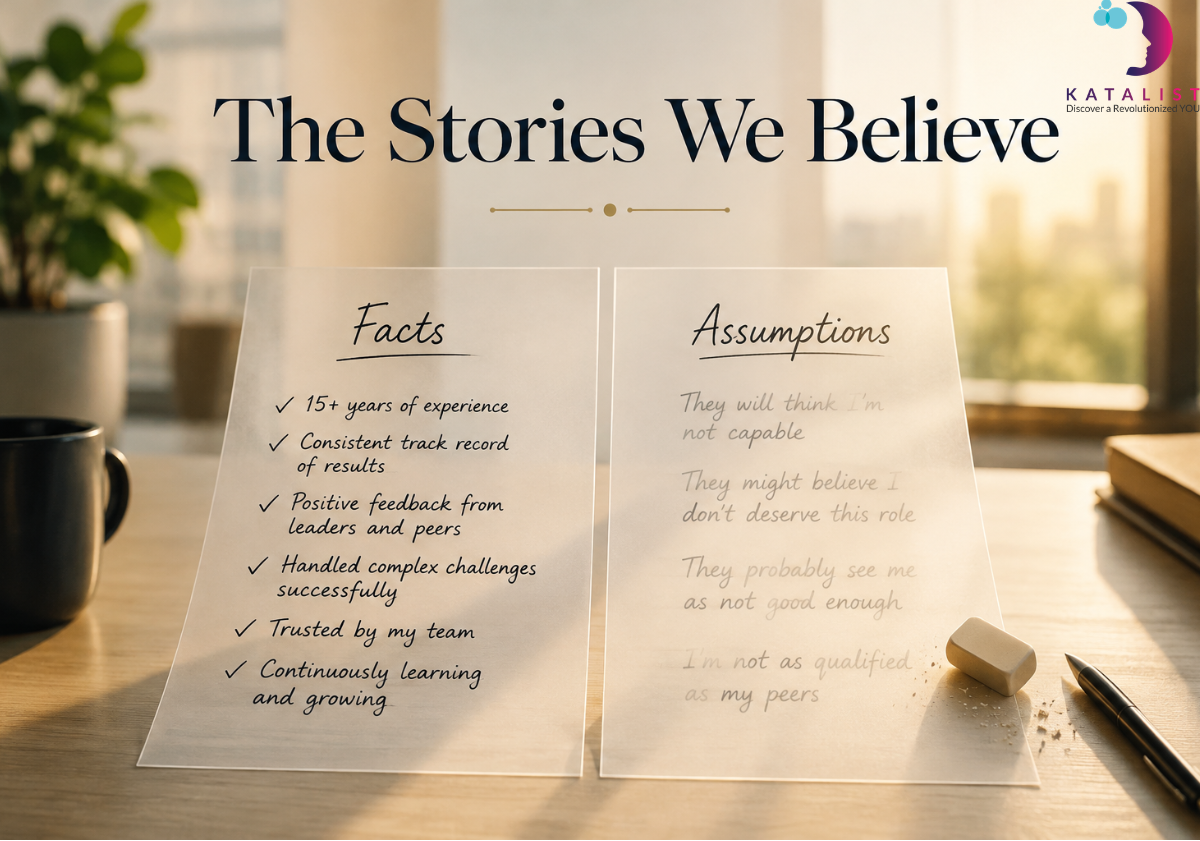
She paused before saying, “I am not as qualified as my peers.”
Then came another thought. “They will think I am not capable.”
“And perhaps they will wonder whether I really deserved to be a Director.”
In just a few minutes, the conversation had shifted from workload to self-worth. The concern was no longer about a colleague leaving. It was about the meaning she had attached to that possibility and what she believed others would conclude about her.
It reminded me once again that the issue we bring into a conversation is not always the issue that needs our attention.
The Quiet Power of Assumptions
What struck me most was not the content of her thoughts, but how quickly assumptions had become facts in her mind. She was not reacting to something that had happened.
She was reacting to something she imagined might happen, and then to another layer of meaning she had added to it.
Her mind had effortlessly connected a series of dots:
A team member might leave.
I will have to handle everything.
I will struggle.
People will notice.
They will think I am not capable.
Perhaps I never deserved this role in the first place.
None of these conclusions had been spoken by anyone around her. There was no evidence that her colleagues questioned her capability or that her leadership was being doubted. Yet emotionally, those assumptions felt completely real.
That is the fascinating thing about assumptions. They rarely announce themselves as assumptions. They arrive disguised as certainty.
Our brains are wired to fill gaps in information. We interpret silence, incomplete information and uncertain situations by creating stories that help us make sense of them. Sometimes those stories protect us. But just as often, they limit us.
A delayed response becomes, “They must be unhappy with me.”
A colleague’s success becomes, “Perhaps I am not good enough.”
An uncertain situation becomes, “I know exactly how this is going to end.”
None of these are facts. Yet we often respond to them as though they are.
The stories feel convincing because they are emotionally charged. And once we believe them, they quietly begin influencing our confidence, our behaviour and the decisions we make.
Separating Evidence from Interpretation
To help my client examine what was happening, I asked her to do a simple exercise.
On one side of a page, I asked her to list all the reasons she deserved to be in her current role. On the other side, I asked her to write down all the reasons she did not.
The first list grew quickly.
She wrote about her years of experience, the challenges she had successfully navigated, the trust she had earned from stakeholders, the results she had delivered and the feedback she had consistently received. There was no shortage of evidence supporting why she belonged in her role.
Then she looked at the second list. It was remarkably short. More importantly, nearly every statement began with phrases like:
“They will think…”
“They might believe…”
“They probably see me as…”
As she read those statements aloud, something shifted.
She realised that the second list was not built on evidence at all. It was built on interpretations, predictions and assumptions.
Nothing in her external situation had changed. But everything about how she saw it had.
The weight she had been carrying suddenly felt lighter because she could finally distinguish between what she knew and what she feared.
The Stories We Believe
I have often wondered how many of our decisions are shaped not by reality, but by the stories we create about reality.
~ How many opportunities do we avoid because we assume we are not ready?
~ How many conversations do we postpone because we assume the outcome will be negative?
~ How many moments of unnecessary stress do we experience because we mistake assumptions for facts?
Perhaps one of the most valuable habits we can develop is learning to pause before believing every thought our mind offers us. The next time you find yourself feeling anxious, discouraged or stuck, take a sheet of paper.
Write down the facts. Then write down the assumptions.
You may discover, as my client did, that what feels like certainty is often only a story waiting to be questioned.
So here is a question to leave you with:
The story you are believing today—is it supported by evidence, or is it built on assumptions?